Black Chasm
2026-07-27
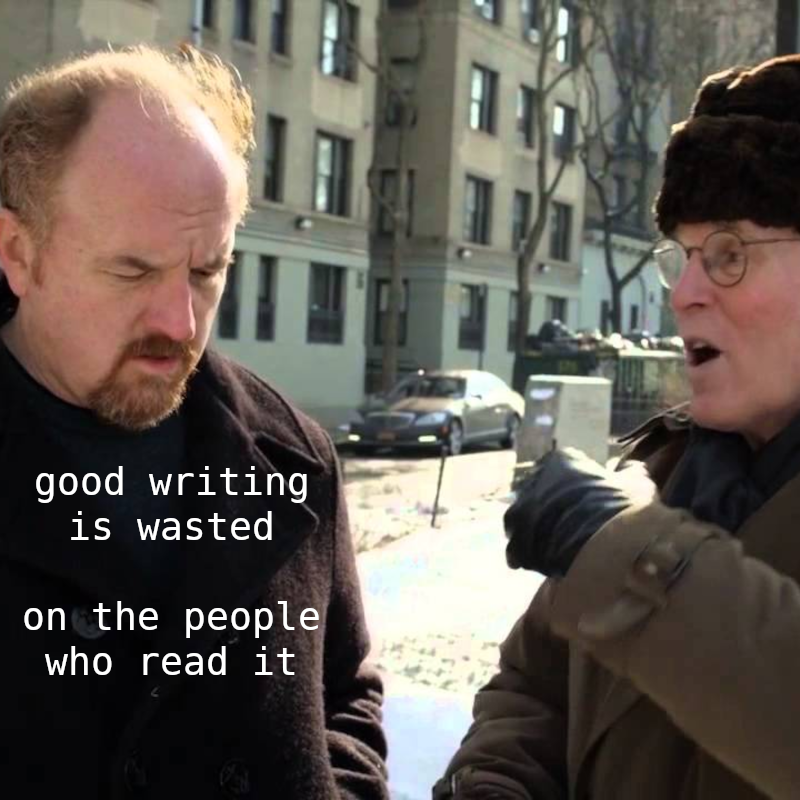
I think the worst kind of writer is not just one who doesn't read, but one who doesn't go out of their way to read good writing. There are many people with blogs or publications who use writing as a means rather than an end. I cannot tell you how many people I've encountered who say something along the lines of, "I want to write because I've got all these ideas in my head and I need to get them out." Those people, more often than not, are not sensitive to the taste of good prose. Because of this, they often write in one of two voices I see most commonly: the first is what I'd call Reddit Voice. I think we've all heard the joke about how Reddit is a hive mind; well, that's the case because they all have the exact same voice in their prose. Most people who want to write don't spend their time reading books, but instead haunt places like Reddit or other big social media sites. As such, they all use the same tone and rhetorical devices; I know you know what I'm talking about. The second is the LLM Voice; even if someone claims not to use AI to write their work, they inevitably adopt its tone or rhetoric because they use it for stylistic edits or general writing advice. LLMs can sometimes give insightful advice, especially to a beginner, but as one improves, they find that monolithic voice exhausting.
I remember a conversation I had with one about writing dialogue in fiction, and I remember this one line in particular: "People don't talk to each other; they talk past each other." This is rather conventional advice, but the first time I received it was from an LLM, which of course made me think it had an original insight. It didn't, but I was fooled for a while. A more practical way I learned to write better dialogue was to study the greats. In particular, I studied some of Raymond Carver's hits like What We Talk About When We Talk About Love and Cathedral. Talk about a master class in good dialogue. While the LLM got me down that train of thought, I tried my best to incorporate the concept and make it my own.
What's worse is that in most publications I read these days, writers' voices tend to be a mix of the Reddit Voice and the LLM Voice, so most people end up sounding benign, fake-energetic, and condescendingly liberal. It seems to be the median go-to style these days, like the Sans Serif of voice. Writing is one of those trades that—particularly for the educated—is relatively simple to start and pull off. However, there's a steep climb for that writing to be anything substantive, and most people don't care to put in the work to figure out how to do that. Quite frankly, at the highest levels, there are many things that can't be taught; it doesn't matter how many videos you watch on how to write, you will never find the secret to excellent prose in a tutorial. Really, the only way to produce excellent prose is to get on the page every single day and produce so much horrible prose that you eventually figure out your mistakes after realizing just how stupid you sounded.
Historically, I have leaned on many different "hedging words." Some of my favorites are "just," "that," and "ultimately." Words like those add unnecessary fat to a sentence and make it lose its weight and punch. The best writing is evocative and flows effortlessly; only the masters can maintain your attention for every single word. Not only does one have to flush out those small details, but they also have to stop being so afraid of themselves. Many are afraid to write what's actually on their mind, usually out of fear of being judged—whether by others or by themselves later. The unfortunate truth is that people are going to judge you anyway, so you might as well have the guts to actually say the thing. That's one of the beauties of writing: it lets you go as deep as you possibly can, and just when you think you can't go any deeper, you find a black chasm that scares you more than any sensory danger ever could.
I'm less concerned with ideas and more concerned with sentences. If a sentence doesn't have that rhythm, and if my eyes don't bounce between words, it's not worth writing down. However, I also know that the only way to master it is to write anyway, regardless of how low-quality it might be. I'm not in the business of being impressive or being seen as smart. I just need that one line—that one perfect line that, when it comes out, will sit there and become that beautiful thing I spent so long working toward. I don't care how many shitty lines I have to write to get it, and I more than likely won't even realize when I've written it. Still, it'll be there—long after I'm gone.
Support my work with Liberapay
Bitcoin address: bc1qtgqvj6qjxnaxkns20x5rcwnxvv3jqzhduvvxfc