Why RSS?
2026-04-18
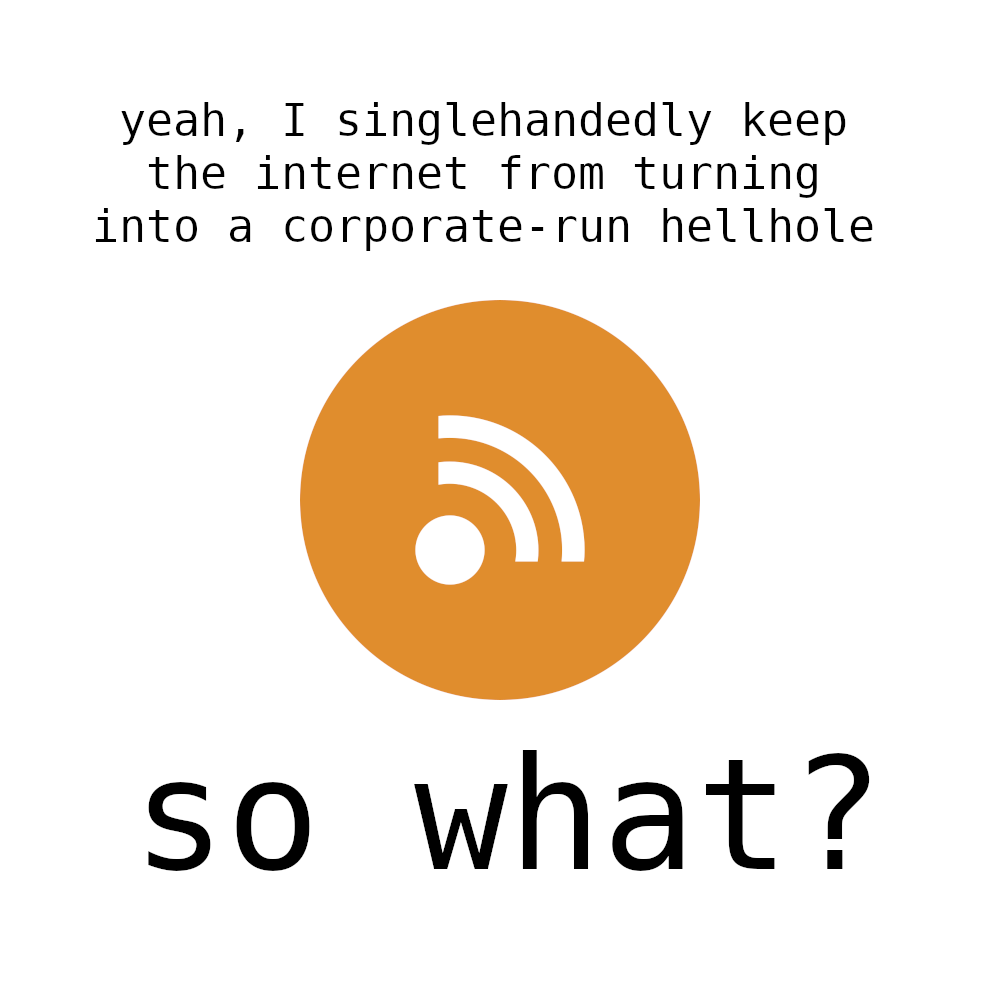
Many sites have an RSS feed. Mine has three.
Don't know what RSS is? I got you covered.
You thought I was gonna try to persuade you to use RSS? Ha, rookie mistake, kiddo.
Even though most people younger than 30 don't even know what it is, it still remains one of the most useful and important protocols for the internet and digital media as a whole. It allows people to stay up-to-date with every website they follow in a way that's totally free of tracking and platform-independent. RSS feeds mostly fell out of style because singular platforms got really—and I mean insanely—good at delivering content to users. Of course, we all refer to it as a monolith: The Algorithm. But let's get real with ourselves here for a second; that term is a scapegoat. All of our woes regarding the internet have manifested into this seemingly never-ending hydra, but the truth is a lot more complicated than that.
A friend of mine told me a statement that has been floating around boardrooms and fancy cocktail parties for some time, that "data is the new oil." It's the Silicon Age's interesting remix of an even older adage, that "knowledge is power." It's a weird collective action problem. To an individual, their personal data isn't worth a ton to them. Why should they care what their search history looks like? Why should they care what their bank statements look like? Sure, finding patterns in those things can lead to valuable personal insights, but those insights aren't always going to be worth a lot of money. However, that kind of information—when aggregated across millions of individuals—suddenly makes dollar signs start to appear out of thin air.
Whether it's advertisers trying to make better ads, retailers trying to track how their products sell, or when a college professor passes out a survey at the end of the semester inquiring about their teaching performance—insights garnered from curated data sets really can give someone an edge in iterating and refining whatever it is they're doing. And of course, it's a multi-billion dollar industry. Don't ask me to pull up numbers, though; I'm a writer, not an academic. But as someone who produces information and entertainment for people to read on the internet, data is important to me, right?
Maybe, but I don't want it to be.
Many people probably look at my site here—an old-school blog on a static website—and wonder why I take the approach I do to deliver my work to readers. Others in my position turn to larger platforms like Medium, Substack, Ghost, Paragraph, or whatever hot writer's platform exists these days. Pretty much all of those platforms offer intensely specific analytics data and easy ways to monetize writing. Thousands of people rely on those platforms to make a living, and those platforms undoubtedly make a significant impact on culture. I used to bemoan that kind of thing, and felt that what those platforms do is unjust. Even outside of those platforms, the internet in general is largely dependent on datamining to sustain most business models it supports. But I found myself facing an unfortunate contradiction: I love the internet and information, and datamining is ultimately what allows my site and work to exist the way it does.
The only analytics I regularly check are the site view stats generated by my host, Neocities. I do this to an almost obsessive degree, and at times I feel bad about it. Thankfully, the data itself is simple—just an estimate of the number of views my site receives each day. I don't see anything beyond that, so no geographic data, no data on post performance, etc. Other than that single dataset, I don't see anything else, and I prefer it that way. I write to be read, but I don't write to please my readers. I write what I do because I want to write it, not because I have any desire to impress anyone who reads my work.
More than that, media has become essentially an infinite resource; well, it's at least one that has a market so segmented and saturated it feels that way. I don't pay for most of my media. If I have to pay to read an article and can't bypass its paywall, I won't read it; the publisher told me it isn't worth my time. Attention and notoriety is a bottom-up thing. It has to come from a mass of people coming to it and if it doesn't, then society doesn't really feel its impact. I don't watch much film/video media these days, but if I do, I don't pay for that either. No, I'm not going to pay to access it. No, I am not going to watch an ad because some company paid you to show their thing to me so I can watch your thing. I just won't watch it. My time is precious to me, and if the information you present is so important, give it the fuck away.
That's why I give my stuff away for free. I don't want to charge anyone to read my work. I don't want any part of my work to be exclusive to those who pay for it. You know why I don't send out email newsletters? Because in marketing circles, they promote newsletter marketing as a means to "own your audience." I'm fine with owning things, but I have no desire to own people. I don't own my audience, and I think they have every right to come and go as they so choose. I don't want to own a database of email addresses. That's another thing with data: if you are datamining and collect a large amount of data, you have to store it and manage it. I try to practice some kind of minimalism in my everyday life, and having too much stuff stresses me the fuck out. Mo data, mo problems if you ask me.
It's an amazing thing to me that I can give people a way to follow my work in a way that works for them without tracking them or having to worry about anything outside of managing my website itself. There's no reliance on third-parties, and the relationship between me and you is completely direct. That's a very cool thing. I don't have to monetize or be beholden to any platform (Neocities is a great host, though. Thanks!), and I have complete creative control over how I wish to conduct myself here. This site doesn't have to be a platform that prioritizes engagement or tries to create some kind of digital community; there's more than enough of that literally everywhere else.
Some critics might say my content management doesn't let me reach the most people, and they are correct. I don't want my work to be read by people who aren't going to take the couple of minutes to switch over to RSS. I have no desire to persuade those people. We had the chance to make RSS mainstream before Big Tech really took over, and we decided not to. Outside of that, the internet promotes discoverability by design. The hypertext will remain on top for decades to come. My intent isn't to reach the most amount of people, but the most amount of right people. If my efforts don't resonate with someone, that isn't their fault or mine. I have no intention of pleasing anyone or catering to any kind of standard, so there's no point in putting myself into someone else's box or playing by someone else's rules.
So uh, anyway, here's my RSS feeds:
Blog: You're here. This is my blog. Good job!
Link Log: Follow this one for links I find to interesting sites on the internet. New editions every Sunday.
Somnia: A novel I'm serially publishing. I'd start from the beginning though. No, I'm not going to tell you what it's about.
Bitcoin address: bc1qtgqvj6qjxnaxkns20x5rcwnxvv3jqzhduvvxfc