Living in the Nowmina
2025-12-16
At this moment in human history, we find ourselves in a paradox: the present moment floods us constantly, yet slips away more easily than ever. There is so much going on all the time and all at once, making it a persistent challenge to live in the moment. The present moment is and always has been in the realm of the noumenon, in and of itself and independent of our experience. But what Kant placed beyond experience now presses against us in real time. With the advent of digital communications, the gap between our minds and the zeitgeist is shrinking. We can get a more immediate and distilled idea of what the world is thinking and feeling, but at the same time feel like we're in a labyrinthine house of mirrors. The poignancy of the post-structuralists feels less like a revelation and more like shattered glass—a fracturing and balkanization of our beliefs and convictions.
The ideals that held up institutions in the past are dots in the rearview mirror, but the road ahead remains uncharted. The great post-structuralist thinkers of the last century had no way of seeing the landscape we find ourselves in today and as such, their models of the world are not as relevant as they used to be. People are distracted by too many stimuli around them. This creates the inability to focus on a single goal or direction and instead, their attention is spread across different interests. I propose a new model that appeals to the 21st century: the Nowmina.
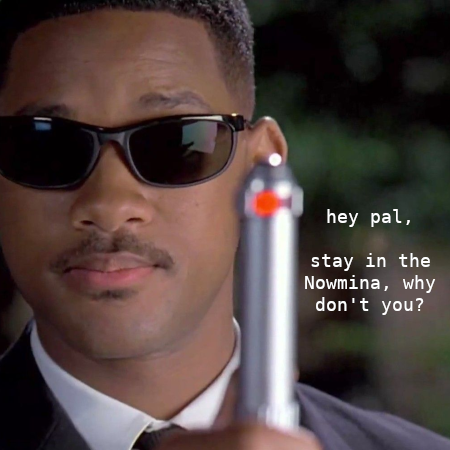
A Definition and Explanation
The Nowmina is a model of thinking in the present moment. It is the awareness of the present moment as a noumenon—something independent of experience and ownership—and to work within that framework to stay attuned to it regardless of our personal biases and conceptions. It is very easy for us to become temporally misaligned and place too much stake into the past or the future. We often misconstrue these periods of time as the basis on which we should experience our reality. Many believe they are a product of where they come from and live in grief over moments that have already passed. In the same way that one can place too much emphasis on the past by letting past actions define us, it is easy to do so with the future as well. People talk about delaying gratification for the future, yet they never let that future come. We often let our anxieties of the future consume us, whether it be through fear of global heating or agonizing over stock futures.
In this age, it is easier than ever to see time as something to possess. The Nowmina as a practice is something akin to a mandala: built on briefly, constantly fading away, and appreciative of that beauty and splendor. It is a dialectical understanding of the illusion of permanence—that every moment is a new essence to independently build upon regardless of what came before or after it. JFK said that America wouldn't go to the moon because it was easy, but because it was hard. There is a greater motivation now more than ever to take this approach not just towards the astronomical, but also the mundane. We live in the Nowmina not to invest in an uncertain future, but to understand and appreciate the impermanence and hardships of the present.
We are at a constant inflection point where today's news becomes tomorrow's history. This inflection point is where the Nowmina lives. Unfortunately, this is also the point where the pulse of the current moment can become distorted and unwieldy forces can attempt to challenge the irrefutable 'capital T' truth of the present moment. This is where the importance of the Nowmina lies: it calls us to respect the essence of the noumenon of the present and live in accordance with it as opposed to letting clouded perceptions and biases impact our relation to it.
To live in accordance with the Nowmina, it's important to limit the noise that digitization imposes. This is not a Luddite charge, but an effort to present alternatives to the way in which we navigate digital space. The teleology of information itself is at its own inflection point. Information is no longer synonymous with knowledge or truth, but circulation and control—a currency all its own. The sheer quantity and speed of the transmission of information is far beyond the mental capacity of any human; where there is speed, there is distortion. To get a better signal to noise ratio, we need to understand the enemies of the Nowmina and how best to combat them. To quote Sun Tzu:
"If you know the enemy and know yourself, you need not fear the result of a hundred battles."
Propaganda and Simulacra: Enemies of the Nowmina
Many large and powerful institutions don't want the general populace to live in the Nowmina. Living in the Nowmina reduces impulsivity and insecurity, things that reliably generate profits for capitalist entities. There are myriad perspectives and motivations in media. People can find any take on any given issue and live in bubbles of ignorance if they so choose. But to truly embrace the Nowmina, we need to understand the intents and purposes of these bubbles and how institutions benefit from people staying in them.
People have been saying that technology like social media has radicalized ideologies and pulled people further towards 'extremes' and away from a sane, moderate 'center'. The thing is that people aren't as far apart as those who manufacture our consent would like us to believe. Minor protests are filmed from dozens of angles, looped on repeat, and packaged as national crises. This sensationalism often presents itself in this conversation as well—the notion that outrage creates engagement and bolsters viewership. News media creates a sense of trust by outlining the 'facts' behind an enraging happening somewhere in the world, keeping people tuned in so that they can 'understand what's really going on'. Unfortunately, these machinations are nothing but an elaborate ruse.
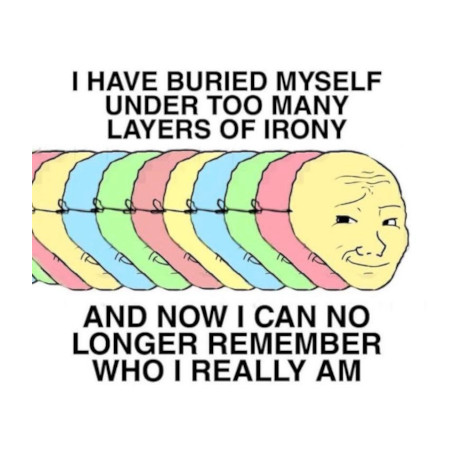
It's clear that most of what people watch on their televisions, phones, and personal computers is some form of propaganda. We are aware of this, yet don't have the organizational skills or language to call it out specifically and have shot ourselves up with fatal doses of irony. Tragedy and depravity are now packaged as 'edgy memes.' It's an irony that has become the song of a bird that has come to love its cage. Even satire can't seem to find its way into the essence of the current moment; it too lives in distortion.
Today, the progression of social media technology has created the ultimate propaganda engine: the infinite feed. It is an algorithmic hydra—a beast that multiplies with each piece of engagement thrown at it. Every swipe and tap creates a unique fingerprint of the user and gives them exactly what it calculates they need. It is the greatest engine of propaganda ever conceived, and we fall for all of it.
Social media embodies the true essence of Baudrillard's simulacrum, a place that feels more real than the real world, yet everything is manufactured and choreographed. People dwell in this hyperreality for hours each day, until keeping up with the kayfabe becomes too exhausting. Disillusionment spreads like a virus; self-awareness becomes a new cancer.
We still have the choice to reject this hyperreality and re-instill the pillars of the real. This is the essence of the Nowmina—and this realization is one that reveals the Nowmina not as a painful truth, but an exhilaration of freedom.
The Nowmina Demands Exhilaration
We all understand doomscrolling. It's a term born out of the fatigue that comes with information overload in the digital age. This level of technology has clearly affected our brains and minds in ways that are unprecedented, but it seems that most people today wish to only discuss the maladies of technology and not the core benefits of it. The days of Frutiger Aero and techno-optimism are far gone. Instead, people turned the benefits into maladies themselves. The propaganda of 'constant connectivity' felt real and innovative, but we didn't see the forest for the trees—a complete upheaval of systemic privacy. People see instant connectivity more as a curse nowadays. Entire families have apps that track each other's location. We feel pressured to tell everyone every little aspect of what we're doing because, well, that's what everyone else is doing, right?
But here's the thing: we have the ability to feel free just as much as we have the ability to feel trapped. People are crafty; there are always options and alternatives. We can choose to browse the same ten sites every day—or figure out how to build a digital life outside that walled garden. It's easy to think that a digital life beyond the mainstream is an uphill battle, but this is a call for liberation. This thought should inspire joy, but joy alone is nothing without practice.
The Praxis
The praxis behind living in the Nowmina is simple in concept, but difficult to achieve in practice. The praxis itself is simple: take the concepts found in asceticism and bring them to digital media consumption. Asceticism itself is a wide-ranging and varied concept handed down over thousands of years from multitudes of religious traditions. But the core principles are straightforward:
Cultivate grounded routines
Eliminate distractions
Discern with divinity
Cultivating Grounded Routines
People have always been creatures of habit. One's entire life can be summarized by their habits. Habitual digital media consumption takes up the majority of our lives these days, so it is important to break down these habits into their essences. Most people live on impulse regarding their digital consumption; if they have a spare few moments, they'll scroll on their phone; the second they get a ping, they read it—and so on. A person living in the Nowmina has grounded their digital consumption routines; they only consume digital media under certain circumstances; they only answer their messages at certain times of day. To live in the Nowmina, it is important to create routines around digital consumption.
Eliminating Distractions
Most people like to see themselves as refined and civilized—the same goes with how they see their minds. However, most people's minds are actually rapacious and savage. The mind of the average citizen is latent with digitized slop, growing ever more obese and lazy. This, unfortunately, is the case by design. If one's mind is constantly inundated with crap, the harder it is for them to be thoughtful of their situation. If true thought were to come to most individuals, they most likely couldn't handle it.
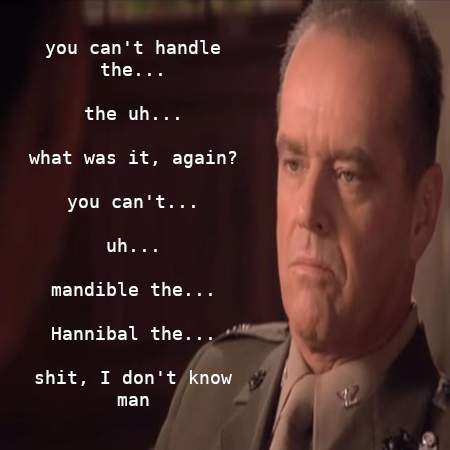
But of course, true thought isn't something that should be embraced as a constant thing. The essence of the Nowmina lies in eliminating distractions so that those doses of true thought come meaningfully and at the proper times. Unless one lives in an actual monastery, distractions can never be fully eliminated. Still though, it's always worth it to reassess every once in a while and find out where distractions happen and do something to mitigate them.
Discerning with Divinity
Monks who practice their ascetic lifestyles do so with the sole purpose of attaining interaction with the divine. In today's increasingly apostate and secular world, the divine has receded from view. Due to the post-Enlightenment and ever more individualist age, many cultures value reason contained within the self and seldom take the time to question where exactly their oh-so-rational thoughts are really coming from. But the monks of the world's religions understand the true source of this rationality: the divine. Whether one views this divinity as trinitarian, unitarian, knowable, unknowable—or something else entirely—doesn't change the fact that it is still, without a question, contributing to the phenomena of the universe.
The most essential praxis to live in the Nowmina is this: to communicate with and come to know that divinity, regardless of whatever shape it may take. It is this divinity that will help us discern the true nature of the noumenon that is the present moment. Only through this contact can perception be purified of distortion; only then can the present appear as it truly is.
This praxis does not involve gate-keeping of any kind. It is available to anyone at any time. There's no need to go to a monastery or some other kind of place. Living in the Nowmina is something that can be done regardless of equipment, environment, or constraints. This is not an elitist charge, but a populist one. To live in the Nowmina is to live with the People with a capital 'P.' But from this practice flows not just clarity, but ethical weight.
A Metaphysical Commitment
The present moment exists as something fragile and democratic. It is our shared noumenon. It is therefore of the utmost importance to preserve our independence from distortion, to dwell within the present moment and witness it without possession. Living in the Nowmina is fraught with dialectical tension. It is difficult to capture the essence of the present while remaining apart from it.
A good way to think about it is like this: we have the ability to record every single moment of our lives if we so choose. Many people record a good portion of their lives and store these moments through subscribing to cloud storage or buying terabytes of hard drives. They don't want to lose certain moments, but what if we let them get lost on purpose? What if we let ourselves forget? Our devices remember everything, but we are blessed with the chance to forget. Through this self-imposed amnesia, we can find comfort in the Nowmina—let the moment come, but find bliss when it slips away.
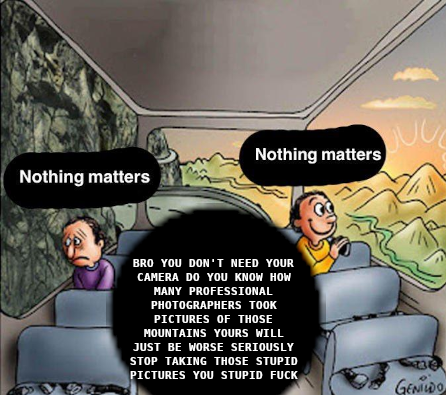
This isn't a charge to stop and smell the roses. Plenty of people do that already. Instead of embracing the present moment, try to let the present exist without assuming it needs anyone's permission. The world is so much bigger than what's in between someone's ears. It was here long before us and it'll be here long after. This thought doesn't instill doom, but offers the opportunity to seek joy. Within this opportunity, however, lies a commitment and a duty: to make this choice over and over again, every single day.
It's difficult to remember living in the Nowmina. There's so much sensory input with every moment that passes. Curating that input carefully is a holistic and distracting endeavor, but still possible. Every click and movement of the cursor is quantified and sold; the world’s markets trade in fragments of our attention. In a world that wants nothing more than to extract essence, it is more important than ever to understand that we are not commodities or derivatives or figures on a balance sheet. We have the ability to sense a higher frequency. All that's left to do is shift the dial.
Tune into the pulse. Live in the Nowmina.