Putting Out Fires
2026-01-24
This morning, while I was making breakfast, my dad was trying to put a nicotine pouch on my sister because he'd heard somewhere that it could help with her symptoms. While he was trying to put it on her, she screamed and cried as loud as she could. I had to cover my ears because it was so loud. She's done this so many times in my life now, yet it still makes me feel deeply sad. More than that, it made me feel afraid. I had to retreat to my room, and it took me about half an hour to decompress from witnessing it. I put on a comforting song, ate my breakfast, and took some deep breaths. I felt my nerves tingling and tears flowing down my face. It brought back a lot of personal trauma, and dealing with it never gets easier.
I still deal with it nonetheless. That's the thing with trauma responses, or really any kind of intense emotional disturbance: they are ephemeral. The important thing I've discovered is that emotions are like fire. They get bigger and more intense if you give them more fuel, but they will always dissipate if left alone. I see my mind as a field of controlled fires.
Each fire is a different part of myself that I tend to. Many of these fires are controlled, but there are many instances when a misplaced spark will start a new one that I don't want around. When I was less battle-hardened than I am now, I would see the fire, freak out, and try to put it out with water. Anyone who has seen or experienced a kitchen fire knows that water only makes it worse
From there, you can either cover up the fire—if it's small enough—or let it burn out if it's too big. Letting it burn out is a tough process. You have to acknowledge that it's there, let it do its thing, and wait for it to burn out. Everything in your mind will tell you to address it somehow—that if you don't do something, it'll get bigger and bigger until it takes over completely. The truth, however, is that it'll get bigger when you do try something. It feels contradictory, which is why it's such an elusive truth. I've had to learn that the hard way in my life, but I'm thankful that I've figured it out.
Unfortunately, the truth is easier known than practiced.
In the past, I've had to deal with my body screaming at me to put out so many fires. I complied so many times. When I'd have a negative experience, I'd try to treat it with a vice—smoke weed about it, huff some nitrous about it, pop a pill about it, jerk off about it, binge-eat about it—whatever it took, really. My body can't see the future like my brain can. My brain will try to convince my body that it's going to be alright in a little while, to "surf the urge," as it's known in recovery. My body, however, does not listen to reason. My chest tightens and my hands tremble. It is the epicenter of the Freudian id, as it were. It's funny how I can let my brain be a slave to it so often.
It made me lose my self-control. My self-control.
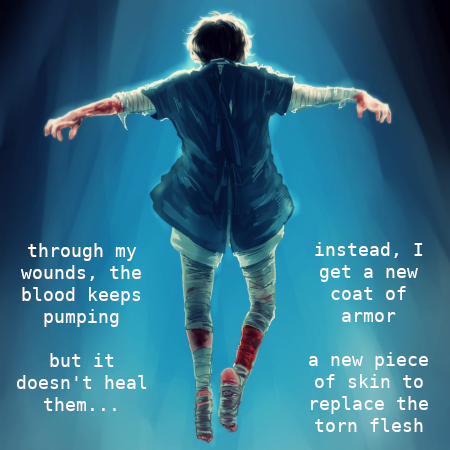
As I've grown in my faith in Christ, I've come to understand a more spiritually refined perspective on my recovery. When I frame my body as the id, I think it's just as accurate to refer to it as Paul does in his epistles: the passions. Of course, cultural context is difficult to parse here. "Passions? I thought it was good to do something you're passionate about! La pasión, hermano." Within sinful passions, however, lie impulsivity and a lack of patience. It's tough because people—particularly Protestants—frame the passions as a failing of moral character. We can feel like it's our fault when we succumb to them.
The truth is that it's a sickness.
Is it someone's fault when they're sick? We don't ascribe blame to a sick person. I see the ailments of myself and others and don't want to feel contempt.
I want to feel compassion.